RESERVE YOUR APPOINTMENT
111 E Jackson Ave, Suite 102 · Knoxville
Monday through Friday, 10 AM to 5 PM, by appointment only. After-hours appointments available upon request.

Home / Treatments / PRP Hair Restoration
For thinning hair in men and women, after a look at what’s causing it.
RESERVE YOUR APPOINTMENTPRP hair restoration
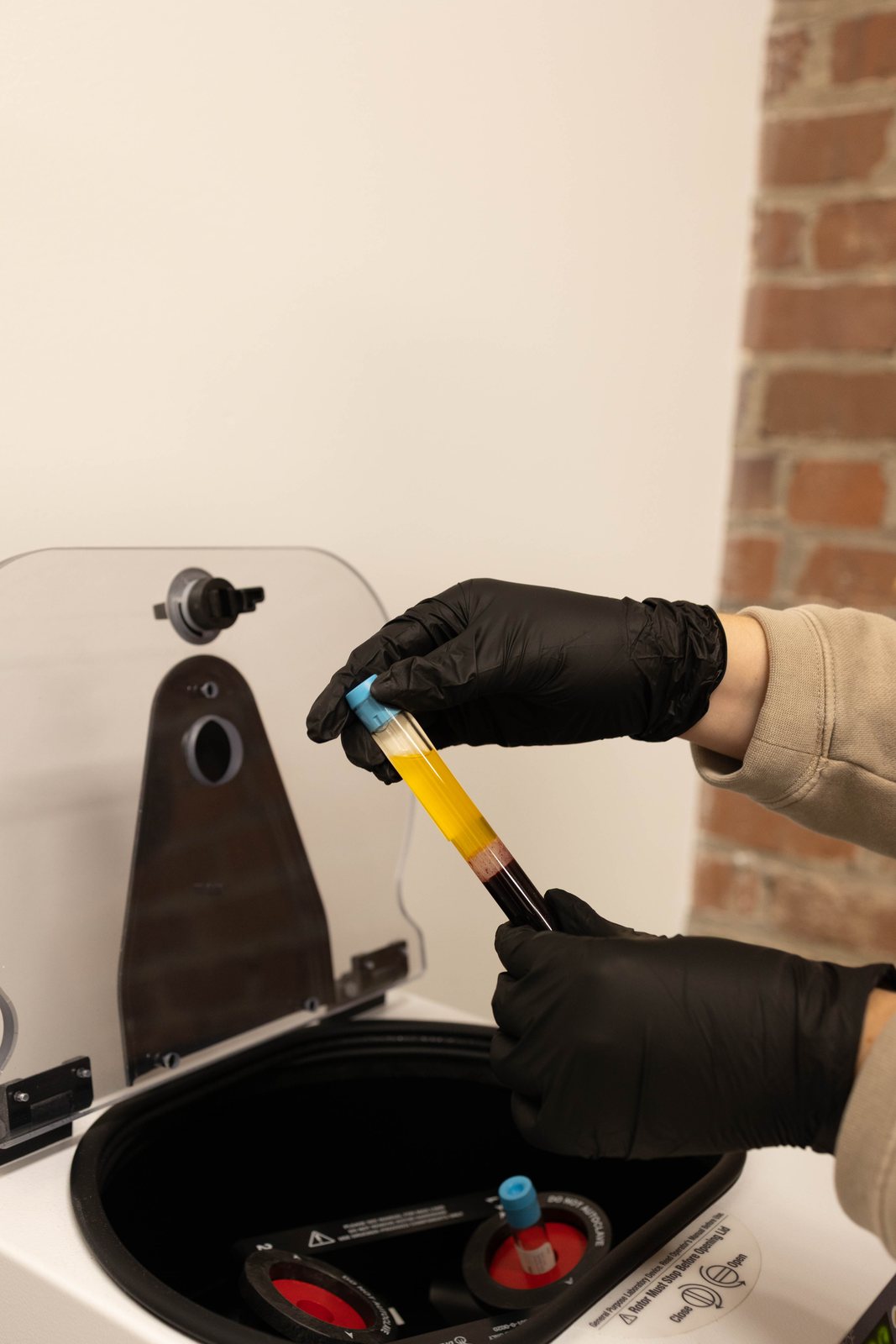
Platelet-rich plasma (PRP) is a concentrated portion of a patient’s own blood, isolated through a centrifuge process that separates and concentrates platelets within the plasma. Platelets contain growth factors involved in the body’s natural healing and tissue-repair processes. When PRP is injected into targeted areas of the scalp, these concentrated platelets may help support follicle activity and the hair growth cycle, with studies showing potential improvements in hair density for appropriately selected patients. Individual response to PRP varies, and improvement in hair growth or density cannot be guaranteed.
The treatment process starts with a standard blood draw, similar to routine bloodwork, followed by centrifugation to concentrate the plasma. That concentrated PRP is then injected directly into the scalp across the treatment area using a fine needle. Because the product comes from the patient’s own blood, the risk of an allergic reaction to the injected material is low. As with any procedure involving injections, temporary tenderness, swelling, bruising, or other treatment-related side effects can occur.
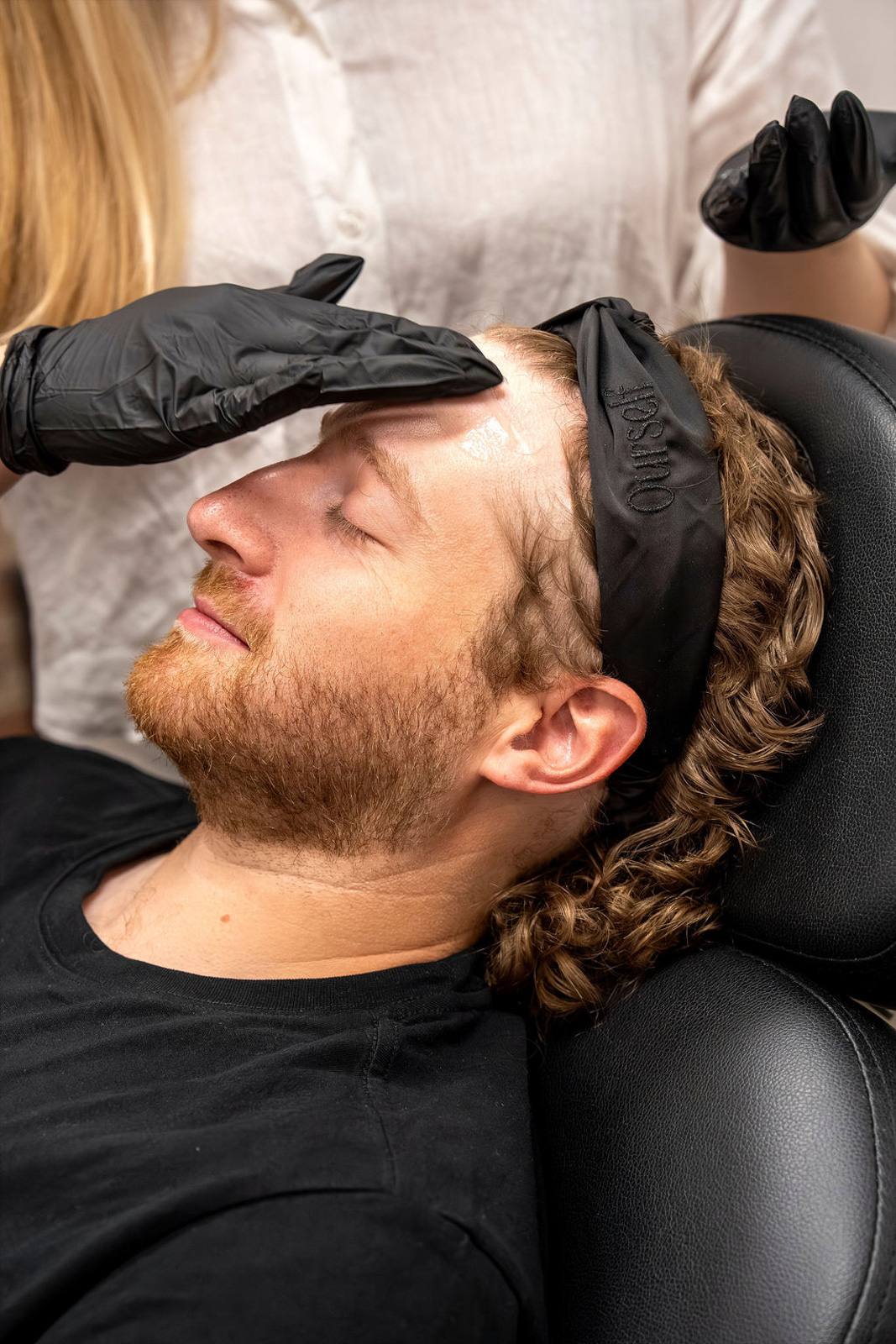
PRP relies on existing hair follicles, so it is generally considered more appropriate for areas of thinning where follicles are still present than for areas of long-standing complete hair loss.
Pattern hair loss may appear as recession at the hairline or thinning through the crown.
More commonly appears as progressive thinning or widening of the part through the top of the scalp.
Sudden shedding, patchy hair loss, scarring hair loss, or thinning related to an underlying medical or nutritional condition may require additional evaluation before treatment.
Results
Real patients, shared with their permission. Individual results vary.
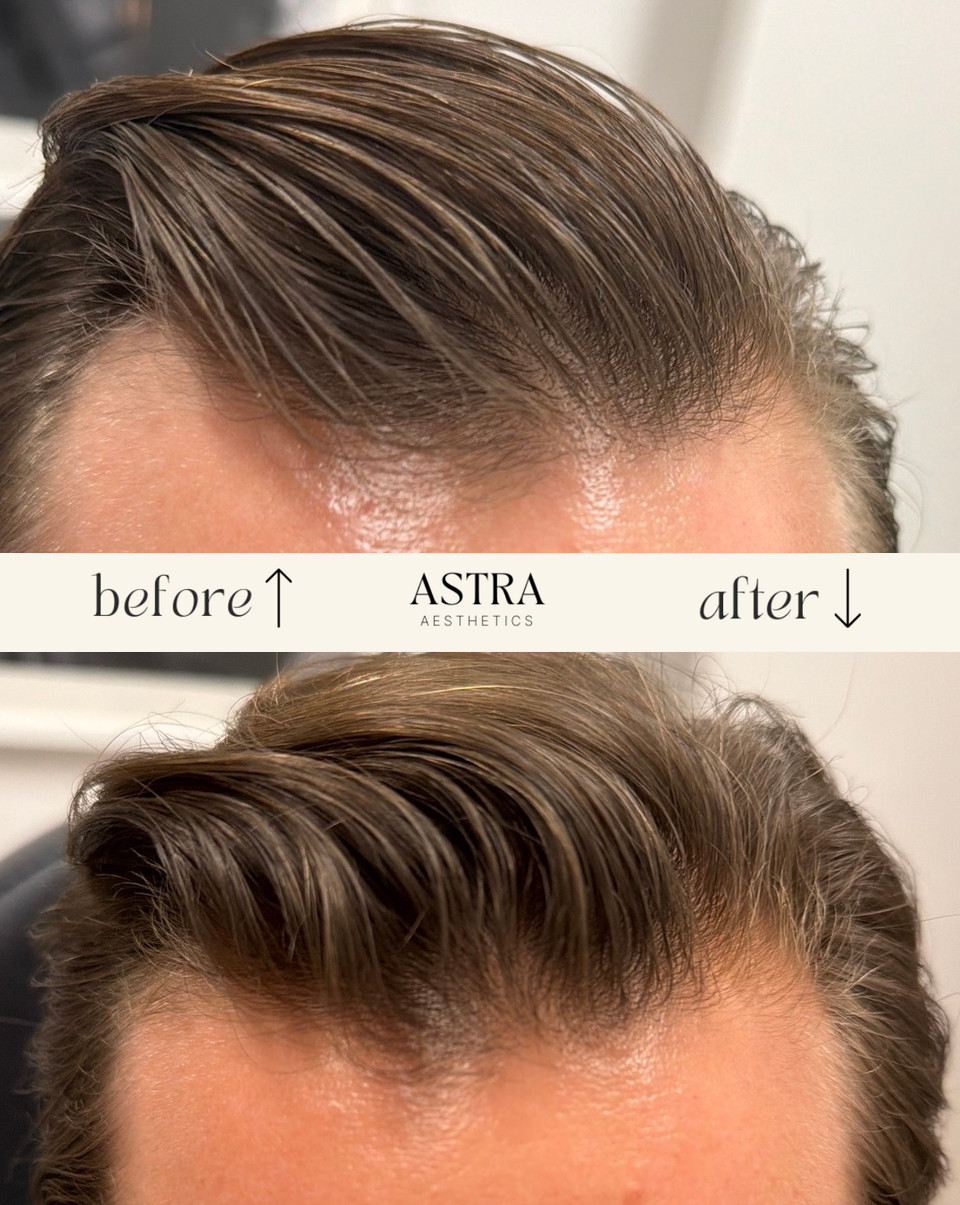
Hair restoration with PRP, front view
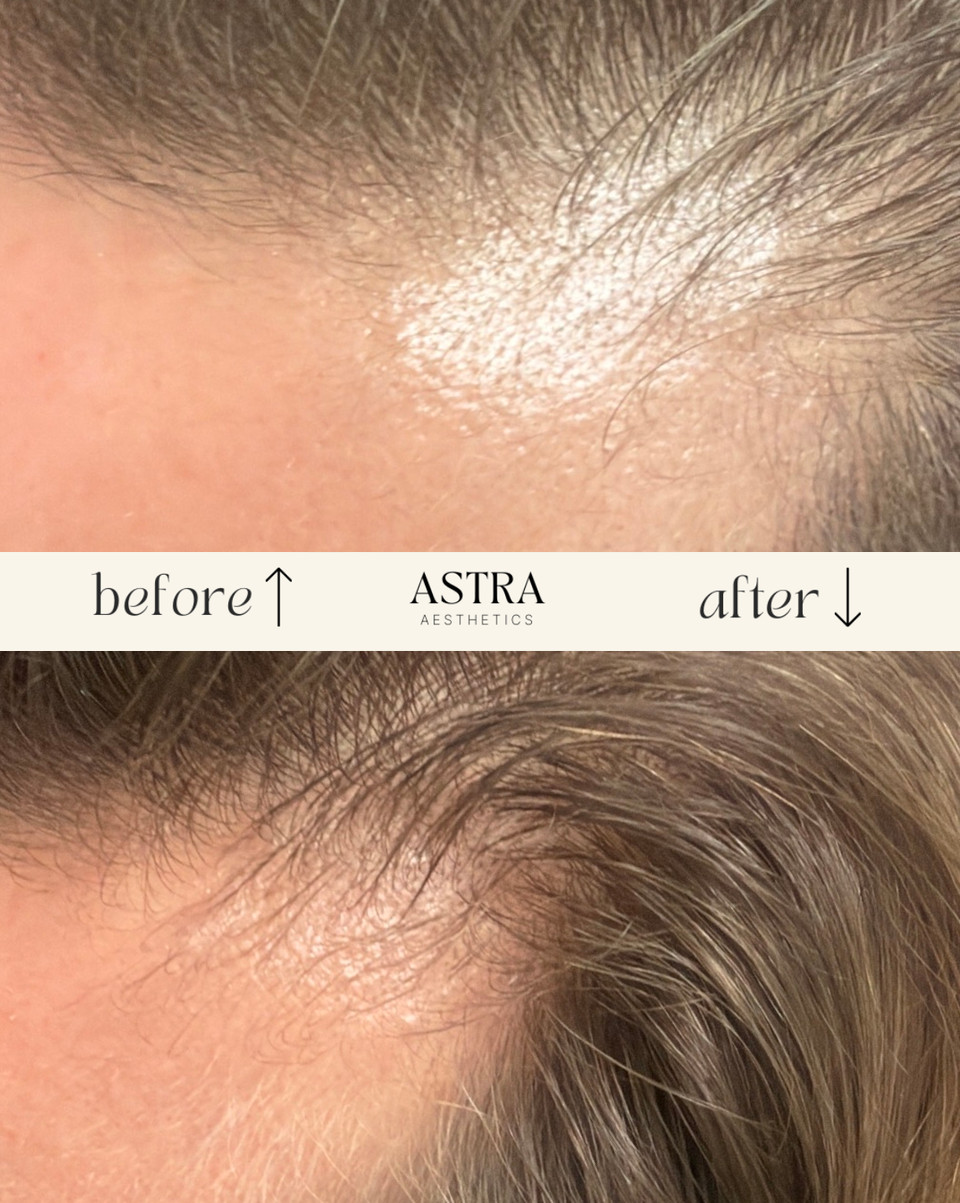
Hair restoration with PRP, side view
Individual results vary. PRP hair restoration does not guarantee new hair growth or improvement in hair density.
Men and women
PRP hair restoration is most commonly used for androgenetic alopecia, also known as male or female pattern hair loss. In men, pattern hair loss may appear as recession at the hairline or thinning through the crown. In women, it more commonly appears as progressive thinning or widening of the part through the top of the scalp.
Hair loss can have many causes, however, and PRP is not the right treatment for every type. Sudden shedding, patchy hair loss, scarring hair loss, or thinning related to an underlying medical or nutritional condition may require additional evaluation before treatment. Molly reviews the patient’s history and pattern of hair loss before determining whether PRP is an appropriate option.

A full treatment plan typically involves an initial series, commonly three to four sessions spaced about four to six weeks apart, although the exact treatment schedule is individualized. Hair growth is slow, so PRP is not a treatment where results should be judged after a single session. For patients who respond to PRP, changes generally develop gradually over several months. Not every patient will experience visible improvement, even after completing a recommended treatment series. After the initial series, maintenance treatments may be recommended based on the patient’s response and the underlying cause of hair loss. PRP does not permanently eliminate the biological or genetic factors contributing to pattern hair loss, so ongoing treatment may be necessary to maintain improvement.
A standard blood draw, similar to routine bloodwork.
The plasma is processed to concentrate the platelets.
The PRP is injected into targeted areas of the scalp. Comfort measures may be used depending on the treatment protocol.
For patients who respond, changes develop gradually. Not every patient sees visible improvement.
What makes Astra's approach different
I don’t think every person experiencing hair loss should automatically be treated with PRP. Hair thinning can happen for many reasons, and the first step is understanding the pattern, timeline, and potential contributing factors. I look at where the patient is thinning, how long it has been happening, whether the pattern is consistent with androgenetic hair loss, and whether PRP is realistically likely to help before recommending a treatment series.
When PRP is appropriate, I also set expectations from the beginning that hair restoration is a process. This isn’t a treatment where I expect someone to see a dramatic change after one appointment. The goal is to support existing follicles and potentially improve hair density over time, with progress evaluated across a series rather than from one treatment to the next. I am also very clear that PRP does not work equally well for everyone. Even with appropriate patient selection and a complete treatment series, results vary and visible improvement is never guaranteed.
A common consultation conversation
PRP is best suited to the patient who notices early thinning, a widening part, more visible scalp, or gradual loss of density and wants to address it before the thinning becomes more advanced rather than someone looking for a treatment to restore hair to an area that has been completely bald for years.
Sometimes the most responsible recommendation is further evaluation before PRP. If the pattern or history suggests another potential cause of hair loss, I don’t want to simply inject the scalp without addressing what may be contributing to the problem.